
Miscellaneous
Buttons, Buckles & Novelties
Sanford and Son
It isn’t every kid whose daddy is in the button business.
That’s how I began an essay for a sophomore writing class at Michigan State. The assignment was to recount a personal experience. I chose the “H. & S. Schwartz Button Co., Inc.—Manufacturers of Buttons, Buckles and Novelties”—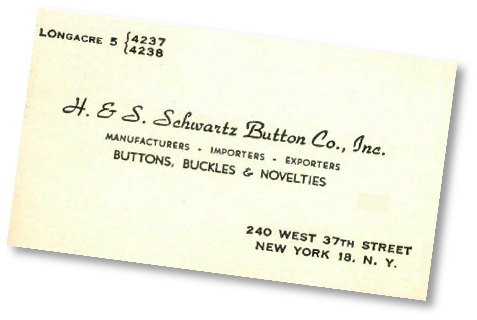 a tale of the family business at 240 W. 37th St. in Manhattan, a narrow sliver of a store wedged into the beating heart of New York’s Garment District.
The professor kept all the papers, so the essay is long gone. But six decades later, I’m back at the same theme—older, purportedly wiser, and with a clearer sense of what the store meant.
And a fuller sense, too, of the man who ran it—a gentle, soft-spoken father who worked dawn to dusk in a dog-eat-dog trade, relentless in work, dedicated to family, and guided by beliefs that would one day clash with the love he felt for me.
Button Store
The store sat mid‑block between Seventh and Eighth Aves., its gold‑leaf lettering on the front window identifying H (Harry, founder and grandpa) & S (Sanford, my dad), proprietors of a wholesale business that improbably occupied ground‑floor real estate.
It was housed in a 10-story workhorse of a building, filled with other jobbers and tradesmen. Dad shared the long and narrow retail space with a sub-tenant, Turnauer & Co., which sold textiles and woolens.
On the Schwartz side: floor to ceiling steel shelving stacked with shallow cardboard boxes as far as the eye could see. A sliding ladder on a rail system gave access to the upper shelves. Each box had a single button fastened to the front—the only way to know what was inside.
Some boxes contained current stock—large buttons for coats, medium for suits, small for shirts and blouses.
Others held remnants from decades earlier—pearl, cloth-covered, and wood—which grandpa treated like archaeological treasures. He believed every button had a future buyer.
Looking for a buckle? You’d come to the right place. Rhinestone pin? H. & S. had stones that could pass for diamonds.
On the Turnauer’s side: two raised wooden platforms stacked with heavy bolts of woolens and synthetic fabrics in an array of colors and patterns. The cylinders stood in tight rows, enough to clothe an army.
Down the center of the store was a long wooden counter where buttons were counted and sorted. It was the workbench where orders were boxed, wrapped, sealed with gum tape, tied in self-locking slip knots, then sent on their way.
There was only one piece of hardware: 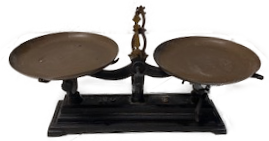 a cast‑iron balance scale with twin metal pans. It was used to weigh buttons by the gross—144 pieces—the trade’s basic counting unit. It was essential to a business that measured profit in small increments.
At the far end of the counter, mounted on the wall, were cardboard sample boards fashioned from flattened shipping boxes. The rows of buttons and buckles showcased the H. & S. Schwartz seasonal offerings, a compilation of smaller glossy cards dad toted in a leather carrying case for sales calls.
And, above everything, perched like a captain’s bridge, was the mezzanine office with a desk, checkbooks, ledger, Royal typewriter, and a calendar featuring a topless Marilyn Monroe, the kind of 1950s–60s pin-up that passed for decor in male-run businesses.
Walk-ins
Grandpa Harry was a presence—not quite retired, not quite active. He answered the black rotary-dial phone mounted in between the shelving sections, minded the shop when my father was out, and handled the occasional retail customers looking to replace a missing button or finish a garment they were sewing at home.
During my summers working there, I also handled the walk-ins. Grandpa would cringe when I’d ask 25¢ for a button for which he could have collected a dollar. Grandpa understood profit. I was the kid who got a D in Econ.
The walk-in transactions, however, were enough to pay for lunch at Dubrow’s Cafeteria, a Garment District institution where I always ordered a cream cheese and jelly sandwich on an onion roll (the whipped cheese piled higher than my mouth could open) with a sour pickle. The countermen grimaced at the combination, but they served it anyway.
On other days, I’d go to the Horn & Hardart Automat in the basement of nearby Macy’s, where food sat behind little glass slots powered by nickels. A quarter’s earnings in those days could buy a roast beef sandwich. No pickles.
Rockaway
The store filled my summer days, but home was at the far edge of Queens, on the stretch of Long Island that still counts as New York City.
We lived in Far Rockaway, a working‑class, ocean‑facing section of the Rockaway peninsula, four blocks from the “FAR R’K’WAY – MOTT AV.” terminus of the A train.  I had the best of both worlds: just enough New York to feel connected, just enough Long Island to feel apart.
A boardwalk ran the length of the waterfront—from Beach 9th St., six blocks from our apartment building, to Beach 126th St., five miles away in Rockaway Beach. 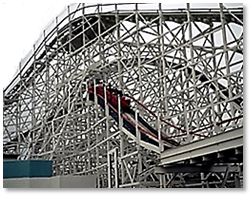 Along its path sat Rockaways’ Playland, home to the Atom Smasher, the wooden roller coaster that rattled moviegoers in This Is Cinerama.
Central to it all was Far Rockaway High School at Bay 25th St., one of the crown jewels of the city’s public school system, which drew kids from Jewish families like mine, Irish neighborhoods farther west, and public housing projects that had replaced aging summer bungalows in the 1950s.
It educated two generations of my family, including dad, my sister Barbara, my birth mom Ruth (dad’s childhood sweetheart, who passed away when I was only seven), and several aunts and uncles. We carried Far Rockaway in our bones.
The Commute
There were two ways into Manhattan by transit—subway and Long Island Rail Road.
The cheaper route was the A train, a double‑fare zone that cost 30¢ (two tokens) and required climbing three levels of stairs to the elevated platform at Mott Ave. The train lumbered across a trestle through the Rockaways, over Jamaica Bay, and finally underground at Euclid Ave. for stops in Brooklyn and Manhattan.
The other option was the LIRR’s Far Rockaway Branch—75¢ to 85¢ for a paper ticket, but with upholstered, reversible seats and a ground‑level station. The train took a wooded path through the ritzy Five Towns in Nassau County before dropping into the tunnel to Penn Station.
My father usually chose the subway, even though a heart scare in his 40s meant pausing at each stairway landing. In those days, 75¢ to 85¢ for the LIRR was real money.
Either way, the trip ended at W. 34th St.—where he took a little‑known elevator inside the New Yorker Hotel to avoid the stairs—before heading up Eighth Ave. toward W. 37th St. and the world that shaped him.
The block announced itself the moment you reached it—trucks double‑parked, engines idling, and drivers shouting over the hiss of air brakes. It was mob turf. Loading privileges were currency; a few feet of curb space could make or break a delivery.
The sidewalks were every man—and almost no women—for himself, pushing rolling racks of garments. Think taxis were a hazard? Try dodging hand trucks.
Inside 240 W. 37th, the pressure didn’t ease. Harry Helmsley—one of the city’s mega‑landlords and no softer than the wife who’d be called the Queen of Mean—was dad’s landlord. Helmsley never left a dollar on the table.
Dad had only one employee, a delivery man. The garment unions, which represented cutters, pressers, and finishers, wanted him on their rolls. The last thing a two‑man shop needed was another layer of bargaining.
Trouble came from every direction. Suppliers had the upper hand, customers stretched payments, and the smallest delay could gum up the works. In a trade built on thin margins, there was no cushion.
Getting buttons to match the color of swatches was the worst of it. Clothing manufacturers demanded perfection, and the dyers never wanted to do anything twice. Dad took heat from both sides.
The furthest thing from his mind was grooming me for the business. His brother, my Uncle Nat, had put in years behind the counter before taking a law degree and clerking for a Nassau County judge. There was no “N” on the window sign, and there was never going to be an “R.”
By closing time, dad would be worn down. He’d head for the 41st St. subway station at Eighth Ave., where the newsstand vendor folded the World‑Telegram—the edition with the closing stock prices—before he even reached the stand. It might be the day’s only easy exchange.
A packed train with the smells of the city carried him back along the reverse of his morning run. At Beach 67th St.—the first Rockaway stop—the doors would open and fresh ocean air would sweep in.
During my summer weeks at the store, my reward came at the last stop: collecting the discarded newspapers at Mott Ave.—seven dailies back then.
Newspapers
At home, I would spread the papers across the living‑room carpet and study them side by side.
I’d compare the morning papers—the lofty Times; the upstart Herald Tribune with its modern typography; the Daily News with a reach the Times couldn’t touch; and the Daily Mirror, its copycat rival and the country’s second‑largest paper.
Then there was the afternoon competition: the Journal‑American with its smudgy ink; the World‑Telegram with the best sports writers; and the Post, a tabloid with stodgy makeup but some of the city’s liveliest columnists.
Dad could see where my interest was heading. I was the sports editor of the Far Rockaway High School Chat and a stringer for the World‑Telegram. I had no taste for the Garment District rat race, but those summer weeks—and tours of newsrooms at the Times, Herald Tribune, and Telly—opened my eyes to the city just beyond the H. & S. doorway.
Crossways
We lived in the Crossways, a five‑story apartment building off Mott Ave. The horseshoe-shaped entranceway was our field of dreams—perfect dimensions for punchball and stickball. Parents gazed down from apartments. The superintendent watched for broken windows.
Far Rockaway High School—three Nobel Prize winners, one Bernie Madoff—was a 15‑minute walk into Bayswater. My father had walked the same blocks for football games long before I did, and long after I’d graduated. Go Seahorses!
We weren’t wealthy. Barely middle class. But dad put both me and my sister through college—private Russell Sage for her, Michigan State for me (out‑of‑state tuition), and later a year of graduate studies at Northwestern, one of the most expensive universities.
He timed the bills against market dips and never said a word about the strain. My stepmother Miriam did. She loved him, but she kept a ledger of sacrifices.
At Michigan State, I became managing editor of the State News. At Northwestern’s Medill School of Journalism, I covered Congress from its Washington bureau. After a two‑year Peace Corps stint in Tonga, I returned to New York and landed a job as a general assignment reporter at the Post.
On paper, everything was working. Dad couldn’t be prouder. But there was a part of my life I kept separate from the stories I filed.
The Secret
I was gay. Many at the Post knew—we ran into each other in the West Village and Fire Island—but no one said anything. It was the 1970s. Silence was the price of employment.
I’d been a reporter for nearly a decade at a time when New York was coming apart—crime spiking, the Bronx burning, garbage piling up during wildcat strikes. My West Village building went without heat for a month. I had enough chaos without adding my own.
I didn’t come out to my family. They didn’t ask.
Don’t Inquire, Won’t Discover.
Then Rupert Murdoch bought the Post. The paper lurched rightward.
I moved leftward—to San Francisco.
The Letters
From 2,500 miles away, I finally wrote the truth.
“I’m writing to tell you I’m gay…”
I didn’t want to live two lives. “My hope is that this will make us closer,” I said.
My father tried to hold himself back. “There is no way I could have trusted myself to write you this letter before today,” he began. The restraint didn’t last.
“Your choice of life is repugnant…you need help,” he wrote, adding he couldn’t understand “how a son of mine could choose this.”
I had the last word. “I am not sick,” I replied. “If you cannot accept me, you will lose a son.” It was the first time I spoke to him as an equal.
We lost each other for years. Birthdays, holidays, ordinary moments.
Before the silence, I told him to talk to Aunt Phyllis—beloved, open-minded, the one we both trusted. She took my side. He told me so.
It was a crack in the wall, but I didn’t step through it.
The Hospital
During those years, dad was dealing with cancer, news relayed to me in brief, strained calls with my stepmother. Then my brother‑in‑law called and said I needed to come home…immediately.
When I walked into the hospital room, dad introduced me to the nurse as his “number one son.”
I told her, “He doesn’t have a number two.”
We laughed. We talked. We avoided the topic that had divided us.
At one point, I asked a question I’d avoided for years: Why had he never spoken about my birth mother after she died?
He explained that a child psychiatrist told him it was best to treat my stepmother as the only mother I knew. He said he was lucky to have had two wonderful wives.
And then he added that he feared I would never experience the joy he had in raising me. I didn’t understand then. I do now.
I mentioned I had arranged a meeting with an editor at the Post. I wasn’t counting on going back, but it gave him hope. That was the point.
I left the room.
A medical alert sounded.
He was gone.
Regrets
Some people claim to have no regrets. I’m not one of them.
I wish I had come out earlier. I wish I had been gentler in my reply.
I wish I had called him during the silence. I wish I had stepped through the crack Aunt Phyllis opened.
I wish I had taken pictures of the store. I wish I had preserved more of the world he built with his hands.
But I also know this: he gave me everything he had.
Long hours. Tuition checks. An example of hard work. A gentle hand.
One final moment of recognition.
And I gave him the truth—late, imperfect, but real.
East Meets West
Son of Sam
Newspaper jobs are hard to land. They’re even harder to leave.
The New York Post was my first professional gig. I hit the jackpot: The Post was the largest afternoon newspaper in the U.S. (700,000+ circulation), in the biggest, badass American city.
Many of my colleagues had to climb their way up the reporting ladder from smaller papers in lesser markets. Others paid their dues as editorial assistants—“copy boys” and “copy girls” in 70s parlance—to ascend from sideline to byline.
Even then, it was conditional. There was a three-month “try-out” before you dared to laminate your press card.
I’d like to say I was hired for my reporting chops (truth is, I was unproven) or valued for my speedy writing (I was more marathon than sprint).
No, my greatest assets as a new hire might have been that I had ink in my veins, was Big Apple to the core, lived in Manhattan, and owned a car. Few reporters had wheels: New York City garage rates rivaled apartment rents; I parked on-the-cheap above a West Village demolition company.
When a story broke, I could hop on my horse and race to the scene. As an afternoon newspaper in the shadow of the morning New York Times, the Post chased local news.
The City Desk didn’t have to waste words:
“Joe Colombo shot—Roosevelt Hospital.”
“Pipe bomb—Polish consulate, 37th and Madison.”
“Guy climbing the Trade Center.”
The Post then and now is a tabloid. But if you’re thinking of tabloids as sensational, gossipy, and conservative, the Post for most of my tenure was unabashedly liberal and featured street-savvy columnist/novelist Pete Hamill and the cerebral Murray Kempton. It catered to left-leaning, middle-class readers.
The publisher, Dorothy (“Dolly”) Schiff, was a New Deal Democrat, one of the few women to own a newspaper. Her firm hand—and tight fist—helped the newspaper prevail over deep-pocketed competitors.
All that ended suddenly in late 1976 when Schiff sold the Post to media magnate Rupert Murdoch. The sale was propelled by a change in inheritance laws that threatened to devalue the Schiff estate.
Also new on the scene in '76 was David Berkowitz, otherwise known as “Son of Sam,” the serial killer driven by the howls of a neighbor’s (Sam’s) dog. The murder spree—six dead, seven wounded—provided grist for Mudoch's Post:
NO ONE IS SAFE FROM SON OF SAM! the front page bellowed during the shooting rampage.
CAUGHT! ON THE WAY TO KILL AGAIN! it blared when Berkowitz was captured.
SAM SLEEPS the Post reassured readers after his incarceration.
Below the headline was a smuggled picture of Berkowitz sleeping in a cell at Attica State Prison where he was serving six consecutive life sentences.
The handwriting was on the front page. Flame-throwing headlines. Large pictures. Short stories. This was a New-New York Post.
I favored human‑interest pieces—“man-bites-dog” stuff—that didn’t fit the new tabloid tempo.
Murdoch’s inaugural year was my last at the paper. Like Son of Sam, I heard voices—and they were telling me to move on.
San Francisco, open your Golden Gate!
I knew the odds of landing another newspaper job were slim to none. Editors are skeptical of interlopers. And I arrived at a time of hiring freezes at the SF papers—homegrown talent was standing in line ahead of me.
To stay afloat, I turned to my own projects, including GUIDEBOARD, a pre-internet digital forum—where to go, what to do in San Francisco—that kept me visible until the right job came knocking.
That was Consumer Reports Travel Letter, San Francisco-based offshoot of the magazine. The job combined reporting, writing, and production. It was the perfect landing place for a recovering tabloid journalist.
When the magazine pulled the Travel Letter back to New York, I found another eager employer in McGraw-Hill. From newspapers to newsletters to books.
After McGraw-Hill pulled up stakes, I took a jack-of-all-trades job at a non-profit, Homebridge, to carry me to retirement.
In 2015, I called it a career. I was age 70, though I prefer the numerals used by reporters to signal the end of a story:
-30-